5 of Swords

take responsibility for your actions

Five brings confrontation + Swords relate it to the mental realm.
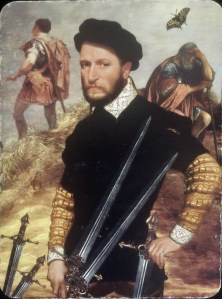
from Touchstone Tarot by Kat Black

And so the Five of Swords asks us what we must confront. The Smith-Waite card shows victory at the expense of others — or a hostile defeat; and reminds us that ethics and conscience fall under airy Swords’ umbrella. Has there been an outwitting? Like a few other cards, it offers the querent the choice of which side they see themselves in (are they the victor or the victim?). The victor here appears selfish and unfair; the others sabotaged and degraded. Gore Vidal said it best with “It’s not enough to succeed; others must fail.” A sense of one-upmanship prevails throughout various interpretations.

I often like to see swords in the imagery as literally representing beliefs, and if we consider this card strictly in this context, it may indicate divisiveness, intolerance of those with different beliefs (or outsiders), arrogance, having the last word, or isolation due to an uncompromising attitude.

This card illustrates a clear power struggle (dominance vs submission). Where do you see yourself in this scenario?

in resistance, we avoid confrontation (which can sometimes lead to passive-aggressive acts). We may have a pattern of conceding to defeat, perhaps with self-pity. Are there times when you could be more assertive? There is integrity in taking personal responsibility and, as Lindsay Mack says, we can either drop into shame, guilt, and excuses or we can recenter and move on.  Sometimes we just need to get ourselves another sword.

Similar to the Five of Wands, we may also refuse to participate in or engage the behavior. In Swords, this may serve as a reminder to choose your battles wisely.

In excess, we should ask if we’re acting with the arrogant traits of the bully. Must we always get the better of others? Take responsibility and make amends if we have hurt others.

Questions to consider when this card comes up may include

  • What must you confront?
  • Is something so important to you that you must prove others wrong?
  • Is there a situation that you could have handled better? Is there some guilt around this? Is there someone to whom you could make amends?
  • What is the ethical thing to do in this situation?
  • Are you conflict-averse? Where did this originate? What parts enable this?
  • Have you adopted a defeatist attitude?
  • Are you always the victim?

There’s lot going on in this card, and more to uncover. How do you see it? How has it come up for you? Feel free to share your own insights.

4 of Swords

retreat, take time to think

Fours offer stability + Swords represent our mind and its thoughts.

from Murder of Crows Tarot

In its centered position on the spectrum, the Four of Swords brings the opportunity to take a time-out to reflect on or reconcile an issue (see the Three of Swords). The stained glass may hint at a spiritual element, suggesting a time to call on our guides. Pamela Coleman-Smith’s depiction shows the medieval practice whereof knights would sometimes commission their tombs and lie on them before (or after) battle to pray (or reflect). A repose to quiet the mind or recuperate, mentally. Sometimes, we need radio silence for a proper mental reset.

In resistance, we’re not taking the time needed to clear our mind and de-stress. Unable to relax.

In excess, we’re fixed in a state of stagnation, perhaps an escape from responsibilities. This card may also indicate a forced rest.

Questions to consider when this card comes up may include

  • Do you need a mental health day? Do you deny yourself of this need out of guilt?
  • Is there something you’re trying to escape from, mentally?
  • What resources do you have in place for times of stress?

What else can we consider in this card? There is much to contemplate (see what I did, there?) and you may have other insights. Feel free to share them in comments.

3 of Swords

Separate your emotional response from the rational

Threes are the response or reaction to the two + Swords relate to our thoughts and mental processing.

from the Herbcrafters Tarot

And so the center or balanced position of the Three of Swords shows realization and reminds us to consider our response. We may realize the truth about something (piercing an illusion?); but here we are reminded to separate ourselves from our emotional response in order to examine what might be objectively true.  Reality as we know it occurs in the space between stimulus and response. Victor Frankl said “Between stimulus and response, there’s a space, and in that space is the power to choose our response, and in our response lies our growth and our freedom.”

This is not a card of emotion, but of realization and truth informing us of how to proceed (remember, threes expand). Consider it, turn it over in your mind, integrate information, and you will then know how to proceed with clarity and grace.

In resistance, the truth may be difficult and we may try to protect ourselves by refusing to see it.

In excess, we’re triggered and we react. What may be a better response?

Questions to consider when this card comes up may include

  • Is there a situation which could benefit by putting things in perspective?
  • Is there a situation you see as a crisis which could instead be an opportunity? How can you step toward that?
  • Is there someone with whom you could clear the air?
  • Has a part been activated and could use some tending?

What else? There are so many more, depending on the spread and surrounding cards. How has this card come up for you? What insight have you gained from it?

2 of Swords

remain objective

Twos introduce an other in duality + airy Swords represent the mental realm of ideas.

from Touchstone Tarot by Kat Black

And so, in the upright or balanced position of the Two of Swords, we are balancing opposing views, striving to see both sides. Can they be reconciled? Must a choice be made, or can we hold the two in balance? In many modern decks, the figure is blindfolded, reminding us to trust our inner knowing for the truth and to remain objective; don’t allow emotion to cloud our judgement.

In resistance, we cannot remain impartial. Info or ideas inconsistent with our beliefs are dismissed or rationalized; cognitive dissonance.

In excess, we remain in indecision, stifled by self-doubt.

Questions we might ask when this card appears include

  • Are you feeling pulled in two different directions?
  • Is there another side of the issue that you’re refusing to see?
  • What factors or events from your past may be influencing your decision?

What else? Of course, this is just a sampling of this card’s spectrum, and you may have other insights. How do you see this card? How has it come up for you? Feel free to share in comments.

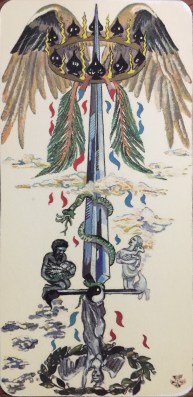
Ace of Swords

believe in your own ideas and give them voice

Aces are offerings or opportunities of the highest potential of the suit + Swords deal with the mental realm of air, and our belief systems.

from the Medieval Scapini Tarot

And so, the Ace of Swords offers an opportunity to bring forward whatever it is that needs to be expressed through us. There may be a challenge to our belief system, perhaps new info or a choice (note that the sword is often double-edged); but the mind is open and we have the clarity to express our ideas and speak our truth.

In resistance, we may not feel ready to articulate. We may be confused or foggy, or don’t have all of the information, yet.

In excess, we may be overthinking.

Questions that we may be prompted to ask when this card comes up include:

  • What keeps you from expressing your ideas? Is there a part that holds you back from realizing your potential? Why?
  • What holds your tongue from speaking your truth? Where did these limiting beliefs come from?

But of course that’s just a beginning. How do you see this card? How has it come up for you? What is your favorite depiction of the Ace of Swords, and how are its shadow aspects portrayed?