Comparison: 9 of Swords

one in a series exploring the intersection of meanings between the Waite-Smith and pip / TdM decks
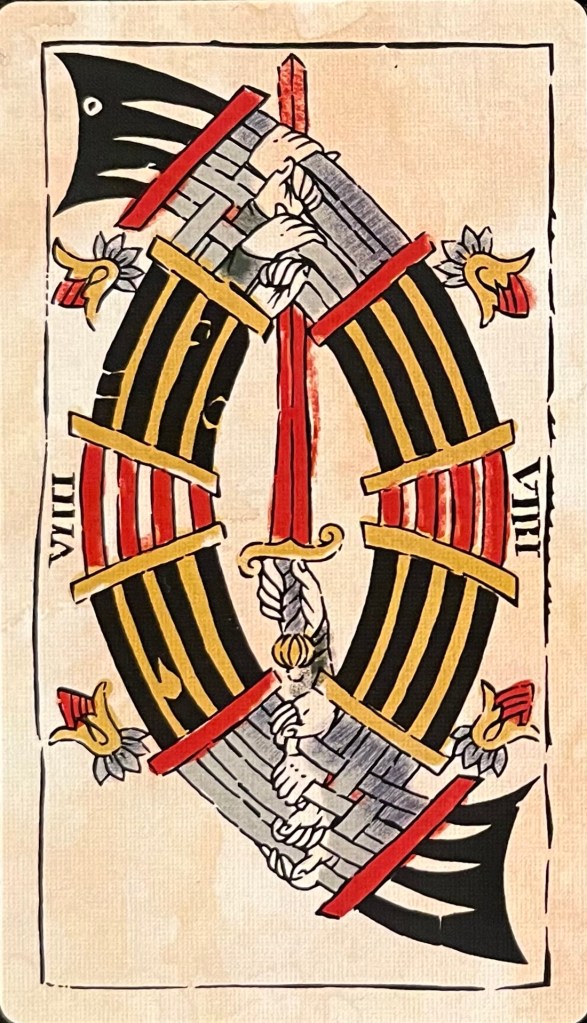
In the Pips, a single sword pushes its way up and out through the barrier of 8 interwoven swords.  It’s a card of victory, but by pushing through; by having the courage to push through them.
(Deck shown at left is Tarot des Ambiguities by Alejandro Rozan and published by Artisan Tarot.)
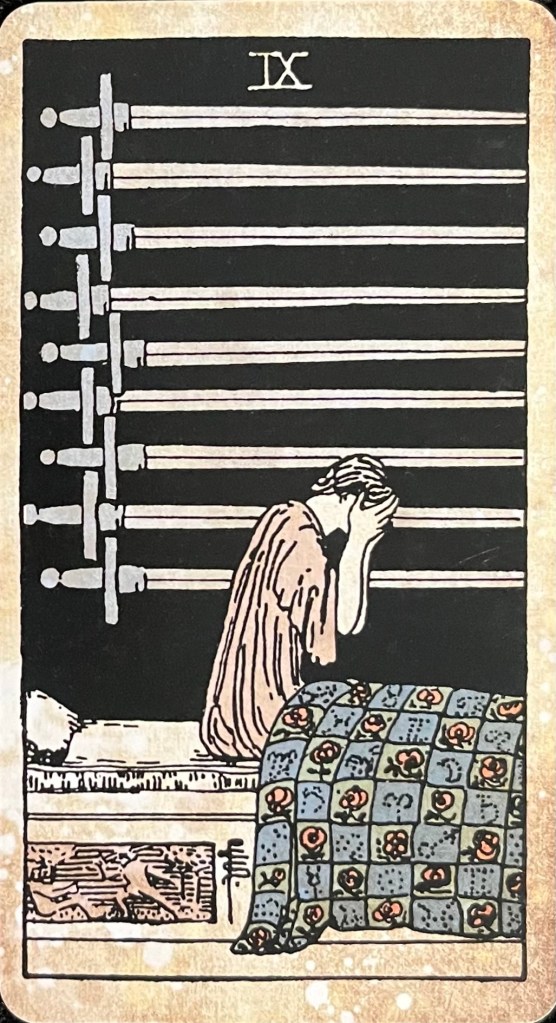
Waite, on the other hand, called it a card of utter desolation, “she is as one who knows no sorrow which is like unto hers.” Death, failure, miscarriage, delay, deception, disappointment, despair.

Pamela Coleman Smith was probably pulling from Romeo & Juliet for her depiction; the carved scene perhaps a nod to Act IV scene III, where a distraught Juliet sees the struggle which ends with Romeo killed “upon a rapier’s point.”

Deck shown above is Tarot Vintage, published by Llewellyn.

In modern decks, it seems to be a card about our worst fears and the ways in which they play (and replay!) on our mind. We listen to these tapes in our heads replaying our anxieties over and over, and we believe them. I have long thought of this card as being about our fears causing us to imagine the worst in spite of reality. Don’t believe everything you think — which could have been advice for Romeo (thinking that Juliet was dead when she really wasn’t), which caused both of their deaths.
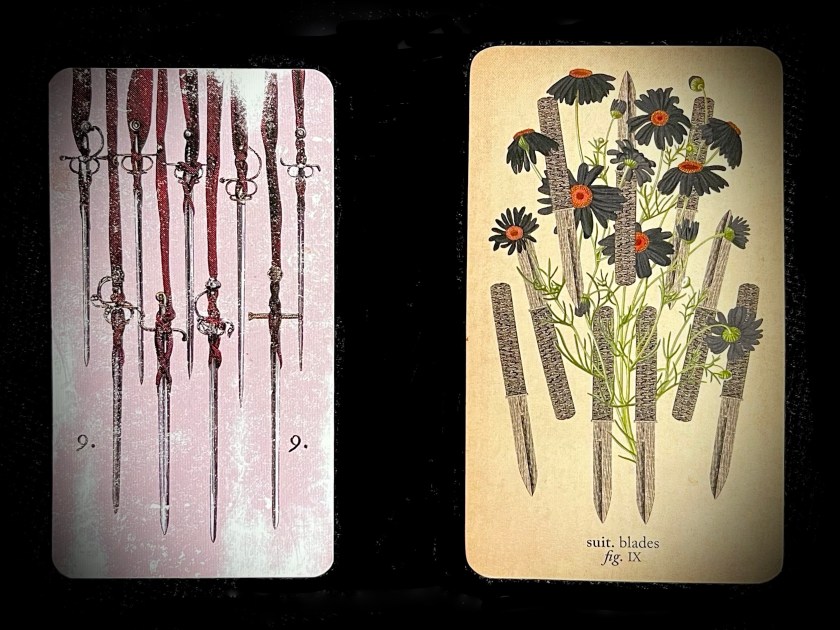
So when I look at a modern pip deck like Tarocchi by Mr Friborg (left) or Antique Anatomy (right) — which are both a modern combo of these systems — how can I approach the pip cards? I go back to the basics of number + suit.

To me, the number nine (in its strive for completion here near the end of the cycle) reconciles + Swords deals with mental processing and our beliefs, so my base meaning is reconciling our beliefs. How do we reconcile them? By having the courage to face them or to question them. That’s how we blast through them.

So, I think these cards intersect at courage. Courage can only exist where there is fear (the shadow of this card). Fears are misguided beliefs (swords). I think the message of this card is that if we can muster the courage to face the truth of our fears, we’ll see that we’ve imagined them. Robert Place notes that The swords above her point to the future. Facing our fears is easier said than done, but as Lindsay Mack said, [paraphrasing] turn on the light, look under the bed, open the closet door, and see that there are no monsters there.

If only Romeo had done that.
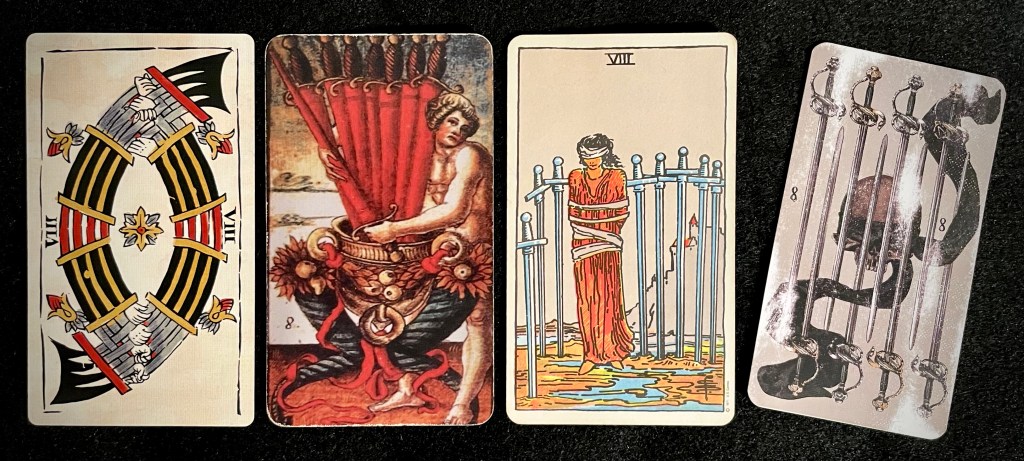
At the Intersection of Waite Smith and Pips

As a lover of classic Italian and other pip decks and having learned to read on Waite-Smith decks, I’m a sucker for decks that mash them together. The Tarocchi by Mr. Friborg is a merger of the two systems and has turned out to be my most reached-for deck, these days. I like how the classical artwork is a morphing of historic decks like Soprafino and Sola Busca while also incorporating little nods to Pamela Coleman Smith’s handiwork, in the pips.

The thing is, I read the systems differently. Pip decks like classic Italian and French Besançon and Tarot de Marseille utilize visual cues, leading the eye to note patterns and directions, interpreting colors, that sort of thing; whereas the Waite-Smith deck was born out of the teachings of the Order of the Golden Dawn, so astrological and other esoteric meanings are imbued in the scenes on the cards (though I like to use them more naturally and introspectively). Add Sola Busca and its enigma of ancient Roman and Greek figures parading through the cards in scenic sequences that may relate to alchemy or the dark arts or whatever, and you have at least three very distinct systems.

So, reading my Tarocchi by Mr Friborg, my logical brain wants to find a common denominator between these systems for each of the number cards or minor arcana. Some are easy, because they have the same meaning (e.g., the 2 of Cups is a partnership or coming together in some sort of relationship across all of them); some have a common theme if you dig a little; and some just stay in their own lane.

To do this, I’m going to the sources of each as best I can. For pip and TdM-style decks, I’m taking a lot from Yoav Ben-Dov’s The Open Reading (retitled The Marseille Tarot Revealed), and of course the little white book or pamphlet that came with each deck, where available.

For Waite-Smith, A. E. Waite’s The Pictorial Key to the Tarot is the guide for the meanings of his deck in his own words. (I’m not going into the more esoteric details like planetary placements and decans of signs.) For the illustrations, I consulted Robert Place’s The Tarot, Magic, Alchemy, Hermeticism, and Neoplatonism, 2nd Ed, as well as Secrets of the Waite-Smith Tarot by Marcus Katz and Tali Goodwin. Knowing that PCS was also inspired by the Sola Busca and by Shakespeare, they’re referenced where appropriate.

There are no key sources for Sola Busca that I know of, or that are available, aside from Peter Mark Adams’s The Game of Saturn, which is a treatise on the deck as symbolic of the dark occult arts, but has been rejected by some (despite it being very well-researched). James Raven did a series of facebook posts dissecting each card, which I found very informative, and will likely be sprinkling in some tidbits inspired by that.

But this is my new project, and I’m really looking forward to finding new layers of meaning in the cards as I try to find that point of intersection for each one. I hope you do, too — and invite you to share your insights!