2 of Pentacles

balance priorities which promote our soul’s growth

Twos aim to balance when an other is introduced + Pentacles represent navigating the material world.

from Darkness of Light (1st ed.)

And so, in its upright or balanced position on the spectrum, the Two of Pentacles invites us to look at what we’re trying to hold in balance. The metaphor of juggling is often used with this card, as the two acts in rhythm and balance, representing the natural flux of life and flow such as cause & effect. Sometimes it’s up, sometimes it’s down (as the ship in the background of the Smith-Waite 2oP, or the tides as shown in this example from Darkness of Light). Sometimes we must borrow from Peter to pay Paul. Life is a series of cycles, and in this two, we must juggle demands, balance priorities, and weigh our options. If we’re working too hard, rest. If we’ve overspent, save money. If we’ve eaten poorly, adjust our diet, and so on.

As we move out of the seed of the Ace, are we prepared to step onto the path of our soul’s work? What are we choosing to juggle? Now may not be the time to try and multitask too much, but to choose to release those responsibilities not in keeping with our path.

In resistance, we don’t make the connection between cause & effect, perhaps oblivious to our causative role in matters. One thing to keep in mind is that if we choose not to step into our soul’s work, we fail to grow.

In excess, we try to keep everyone happy and, in misplacing our priorities, we struggle to keep all of the balls in the air.

Questions we may ask when the 2oP comes up include

  • Where do you feel out of balance in your life?
  • Are you feeling pulled in opposite directions? Which serves you better?
  • What are you struggling to juggle? Why do you continue to do so?
  • Is there an aspect of your life that you’ve been ignoring? Why do you do so?

What else? Of course, this is just a sampling of this card’s spectrum, and you may have other insights. How do you see this card? How has it come up for you? Feel free to share in comments.

2 of Swords

remain objective

Twos introduce an other in duality + airy Swords represent the mental realm of ideas.

from Touchstone Tarot by Kat Black

And so, in the upright or balanced position of the Two of Swords, we are balancing opposing views, striving to see both sides. Can they be reconciled? Must a choice be made, or can we hold the two in balance? In many modern decks, the figure is blindfolded, reminding us to trust our inner knowing for the truth and to remain objective; don’t allow emotion to cloud our judgement.

In resistance, we cannot remain impartial. Info or ideas inconsistent with our beliefs are dismissed or rationalized; cognitive dissonance.

In excess, we remain in indecision, stifled by self-doubt.

Questions we might ask when this card appears include

  • Are you feeling pulled in two different directions?
  • Is there another side of the issue that you’re refusing to see?
  • What factors or events from your past may be influencing your decision?

What else? Of course, this is just a sampling of this card’s spectrum, and you may have other insights. How do you see this card? How has it come up for you? Feel free to share in comments.

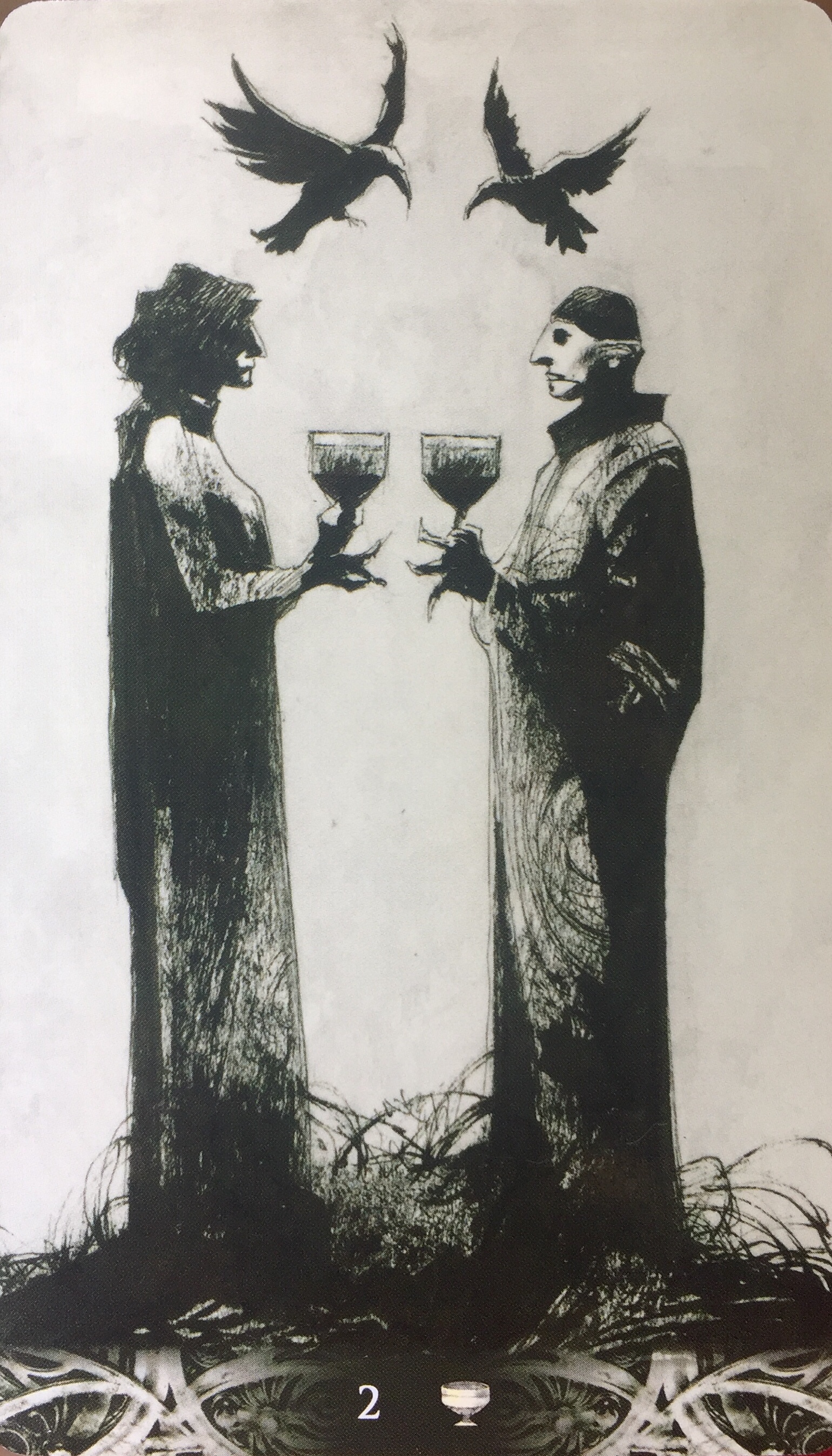
2 of Cups

look into the mirror of the other

Twos take us from the sole oneness of Ace to the introduction of an other + watery Cups represent feelings and relationships.

from Murder of Crows Tarot, by Corrado Roi

And so, in its upright or balanced position on the spectrum, the Two of Cups is a coming together in relationship — whether a partnership of some sort or as the integration of parts within the self. It invites us to look into the mirror of the other and see ourselves reflected back. Can you accept what you see? This card’s most fundamental message relates to the age-old advice that you will not find love in another if you can’t find it within yourself. It’s important to remember that this card isn’t necessarily about romantic love, but about relationships and love of all kinds, including self.

In resistance, we find incompatibility between the two, or we separate. We may be rejecting a part of ourselves. It may also hint at an independence which rejects others.

In excess, we become dependent on another to compensate for a perceived lack in ourselves which we see reflected. Co-dependency.

Questions we may ask when this card comes up include

  • What part is preventing you from reaching out due to pride or fear?
  • What attracts you to another person in friendship, collaboration, love, etc.?
  • What irks you in another person in friendship, collaboration, love, etc.?
  • What painful event from the past do you need to make peace with in order to heal and move on?
  • How do you balance solitude and connection with others?

What else? Of course, this is just a sampling of this card’s spectrum, and you may have other insights. How do you see this card? How has it come up for you? Feel free to share in comments.

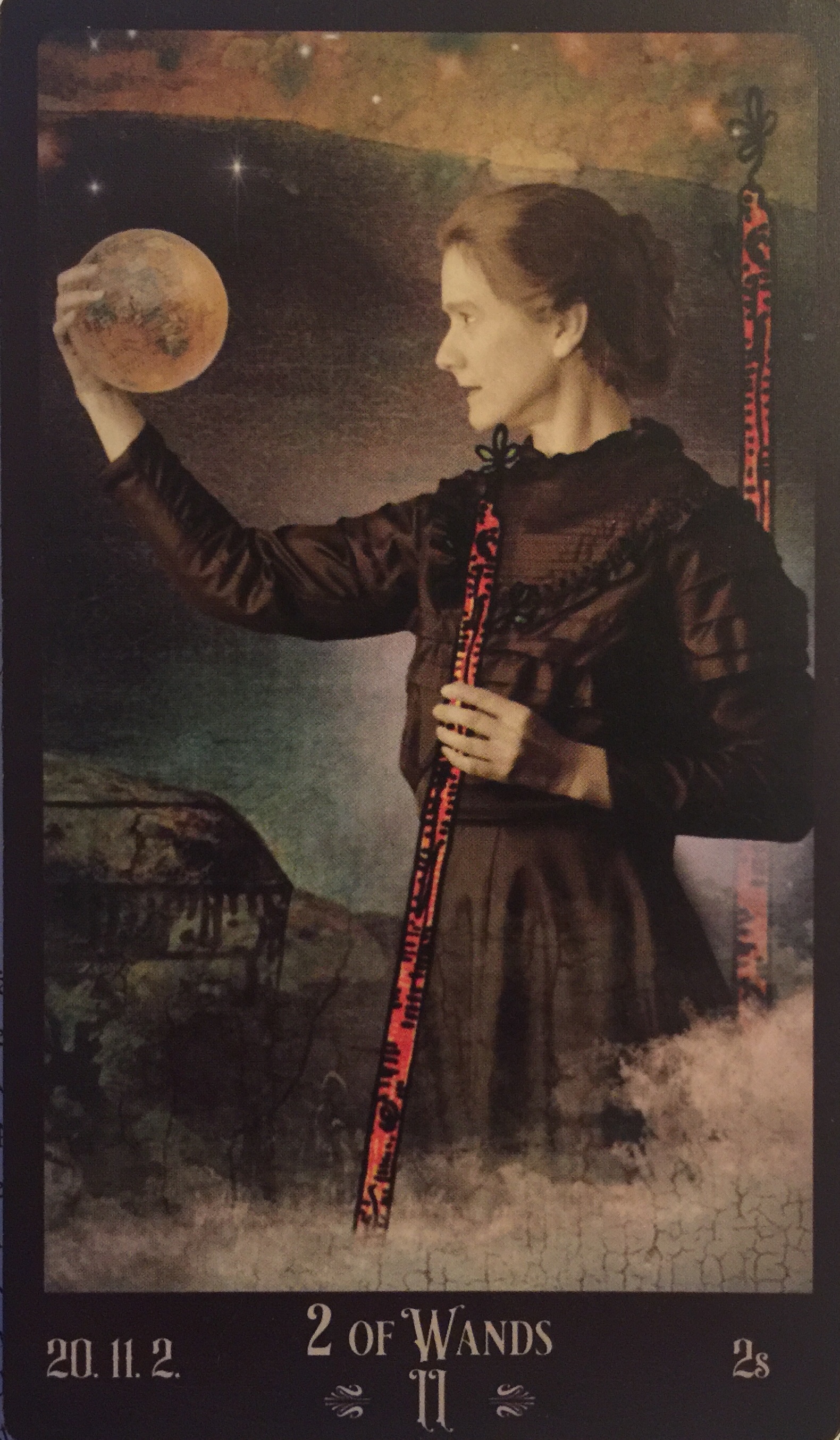
2 of Wands

Take the initiative to explore outside of yourself.

Twos take us from the sole oneness of Ace to something outside of ourselves + Wands represent energy and identity; the life force that drives our actions.

from The Relative Tarot

And so, in its upright or balanced position on the spectrum, the 2 of Wands is standing at the threshold, considering the initiative to go beyond what we’ve been comfortable with and allowing ourselves to explore new territory; to reach out; to set goals; sending out our ships, sharing something of ourselves with the outside world. We may be confronted with a choice between inner emptiness and outer fulfillment; between action and inaction. Will we forge a new path or choose to risk nothing?

When this desire is blocked, we may have some hesitancy or indecision around this outward venture, or we’re stuck in a pattern of complacency. For some, negotiating the outside world can be challenging. What holds us back?

In excess, we’re never content with what we have, always searching elsewhere for gratification, or for something bigger & better.

Questions we may ask when this card comes up include

  • Is there a part of you or an identity that’s ready to be brought forward?
  • How are you holding back? Why might you be doing so?
  • Are there competing desires you’re trying to integrate?
  • Is there something about success that frightens you? What might that be?

What else? Of course, this is just a sampling of this card’s spectrum, and you may have other insights. How do you see this card? How has it come up for you? Feel free to share in comments.

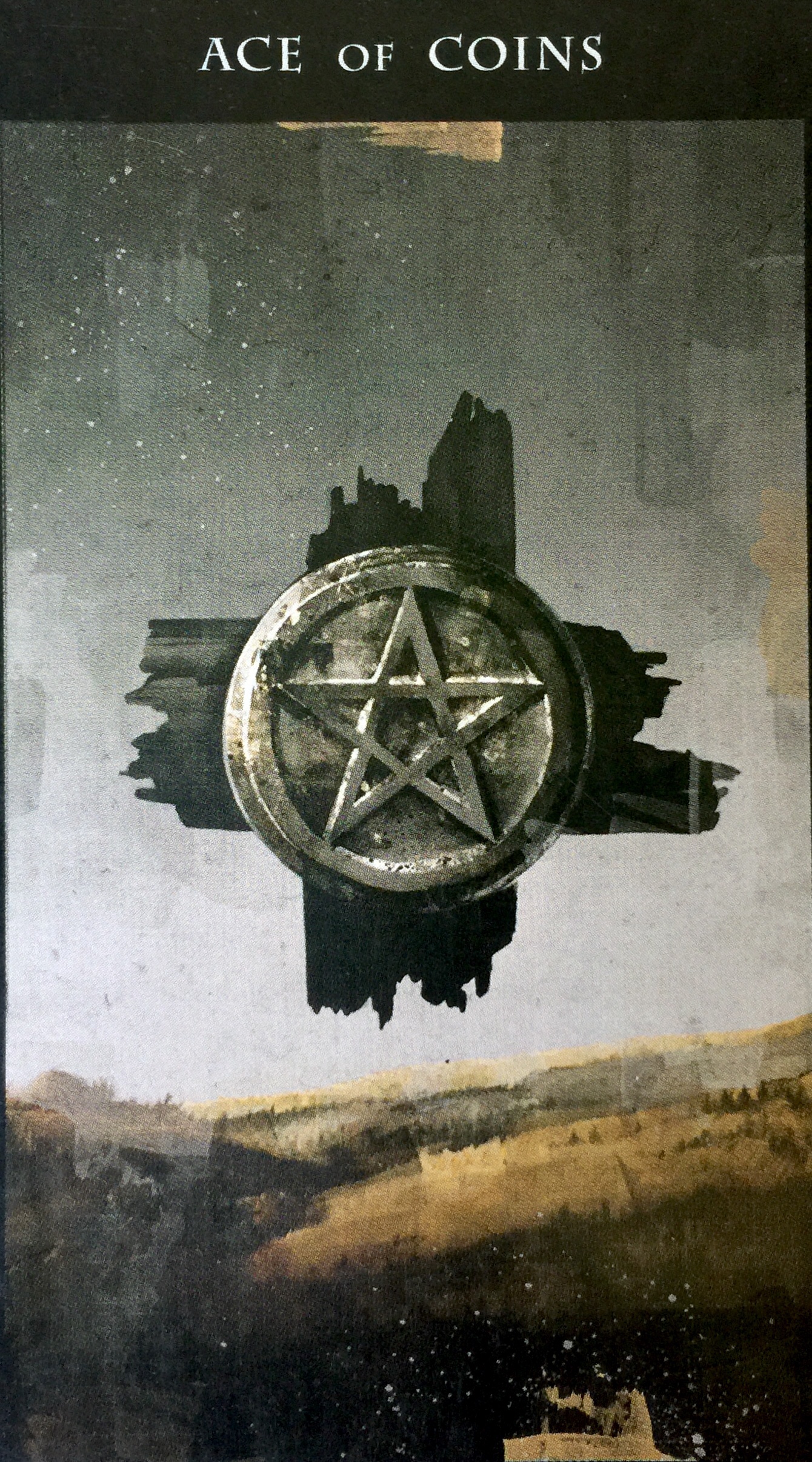
Ace of Pentacles

take the first tangible step to bring your intention to form

Aces are offerings or opportunities of the highest potential of the suit + Pentacles deal with the physical domain of earth, and how we as spiritual beings navigate the material world.

from Darkness of Light (1st ed.)

And so the Ace of Pentacles, Disks, or Coins is the potential or foundation for manifesting in the earthly realm. It asks us to get out of our head and implement that  desire, dream, idea; take the first step to give it concrete expression. (This is the Ace that brings the others to tangible form.). This journey will likely take time and require tending, like the seed we plant in the soil of our garden and nurture.

In resistance, we’re stuck. We just can’t move beyond our thoughts and dreams. What holds us back from taking the first step toward manifesting? Perhaps we doubt our ability to manifest.

In excess, is there an overemphasis on the material or physical, of security, or some other aspect of earth?

Questions that we may be prompted to ask when this card comes up include:

  • What seeds are you planting?
  • What prevents you from pursuing your soul’s work?
  • Do you feel secure? Is there a part of you that does not?
  • How is your health? Do you get the physical exercise and nutrition that your body needs? How is your relationship with food?
  • Do you have a need for more time connecting with nature?

But of course that’s just a beginning. How do you see this card? How has it come up for you? What is your favorite depiction of the Ace of Pentacles, and how are its shadow aspects portrayed?

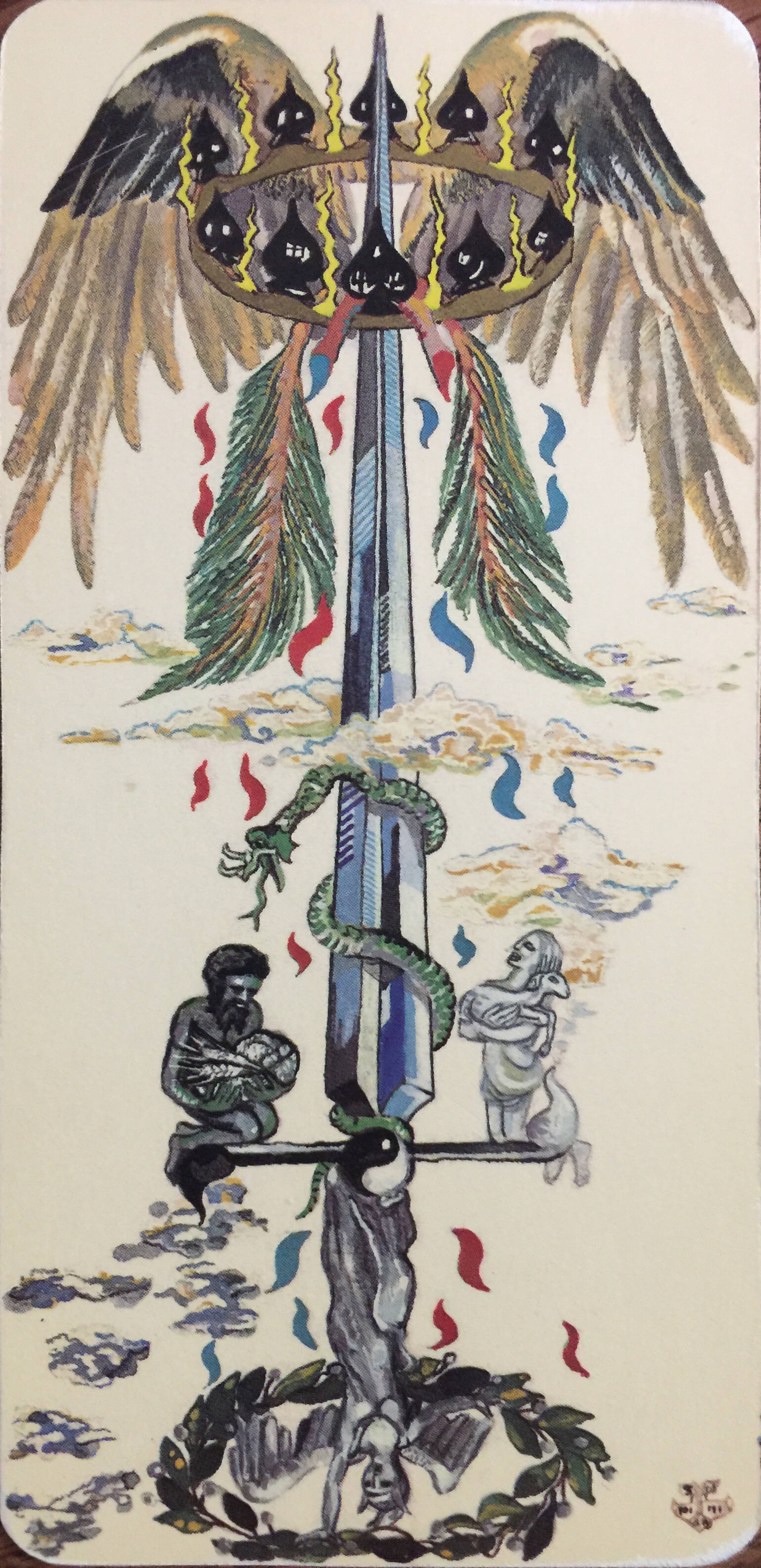
Ace of Swords

believe in your own ideas and give them voice

Aces are offerings or opportunities of the highest potential of the suit + Swords deal with the mental realm of air, and our belief systems.

from the Medieval Scapini Tarot

And so, the Ace of Swords offers an opportunity to bring forward whatever it is that needs to be expressed through us. There may be a challenge to our belief system, perhaps new info or a choice (note that the sword is often double-edged); but the mind is open and we have the clarity to express our ideas and speak our truth.

In resistance, we may not feel ready to articulate. We may be confused or foggy, or don’t have all of the information, yet.

In excess, we may be overthinking.

Questions that we may be prompted to ask when this card comes up include:

  • What keeps you from expressing your ideas? Is there a part that holds you back from realizing your potential? Why?
  • What holds your tongue from speaking your truth? Where did these limiting beliefs come from?

But of course that’s just a beginning. How do you see this card? How has it come up for you? What is your favorite depiction of the Ace of Swords, and how are its shadow aspects portrayed?

Ace of Cups

expand your capacity for compassion and healing

Aces hand us an opportunity to step up + Cups rule the domain of water, representing our emotional experiences and how we relate to others.

from Sola Busca Revisited by Tarot by Seven

And so the Ace of Cups reminds us to expand our capacity for compassion and fulfillment in whatever situation is coming up (whether toward self or others). As a beginning, it may signal a new experience or relationship of some sort with the potential for contentment, and offers us a chance to more deeply consider what we’re available to receive or take part in. Holding the opportunities of our emotional life, there is an emphasis here on our emotional health, our subconscious and its parts. How connected are you with your internal parts? How can you better connect with and accommodate their needs?

Because of its connection with emotions and how we relate to others, Cups are often associated with love, and an important aspect of this is that the emanations of our earthly [small L] love are reflections of divine [big L] Love. Traditional Aces of Cups show an ornate chalice or grail, symbolic of religious practice or rites, and of the mystical nature of water — the spiritual aspects of connection, the availability of Spirit (or what you perceive as God) and of the spirit realm, and of our capacity to reach outside of the physical plane. This Ace reminds us that we don’t need a mediator to do that for us; we can access other realms directly. How connected are you with your spirituality or a higher power? What do you hope to cultivate in spiritual practice? How available is your heart to reach up and take that cup?

In resistance, we withdraw. Our heart isn’t available for connection with others, this new experience, or acceptance (whether socially or of the self). What parts of you feel the need to protect your heart?

In excess, we may hold unrealistic ideals in this new experience or relationship. Are we a little starry-eyed? There may also be a potential here of love-bombing. What’s motivating that?

…But of course that’s just a beginning. How do you see this card? How has it come up for you? What is your favorite depiction of the Ace of Cups, and how are its shadow aspects portrayed?

What Exactly is Shadow Work, Anyway?

We see a lot of mention in tarot circles of shadow work, but what is it, really? It seems to be increasingly trendy in social media, and the term is often thrown around without much explanation or context, so a proper explanation is in order.

Shadow work is a term coined by Carl Jung to describe the collective parts of the psyche which we suppress from consciousness as the least desirable aspects of our personality. He called the shadow “the thing a person has no wish to be.” The more these parts are denied and suppressed, the darker and denser the shadow becomes; thus the more likely they will slip out during our daily interactions, when we least expect them or understand what they are suddenly doing there. Our projections about others, our slips of the tongue, our addictions, our dreams, even our physical symptoms are the manifestations of these parts that have been denied another outlet. We all have a shadow as part of the Self, no matter how much inner work we may have done, and this work can never truly be finished.

The goal of shadow work is to identify those deeper parts and engage compassionately with them to bring them up to the light, so that we may correct their functions and better integrate them into the known parts of the Self. This requires a lot of honesty with yourself. The approach that I like best is to engage them in open dialogue to better understand their role. Most shadow parts are trying to help the Self, and believe they’re doing so. By offering it acceptance and a channel for compassionate communication, we can better understand why and how it’s functioning, and perhaps guide it to a new job in the psyche – one more productive.

So, how do we use tarot in shadow work? I should start by stating that tarot shadow work is absolutely, in no way, shape, or form, an alternative to psychotherapy. If we have complexes which are causing dysfunction in our lives, we really need to consult a trained mental health professional. While health care in the U.S. (never mind mental health care) is often not accessible to those who need it most, there are resources such as betterhelp if coverage is a barrier for you.

Done seriously, shadow work can be an arduous and lengthy process; it really shouldn’t be glamorized and isn’t really meant to be done with a single simple tarot spread. Search Instagram with #tarotshadowspread and you’ll get hundreds, in all shapes and colors and sizes — many so vague or generalized that you’re left with no real insight or next step after having done it. They often portray the shadow as one entity when it’s really a multitude of different parts functioning in complex relationship with the others to, say, protect more sheltered parts or to manage the environment to reduce harm. Sure, these generalized spreads can be helpful in identifying things to work on, but the work doesn’t end there. Shadow work is often a difficult and messy process of reliving old wounds and grinding through the painful memories of a younger you and committing to new practices.

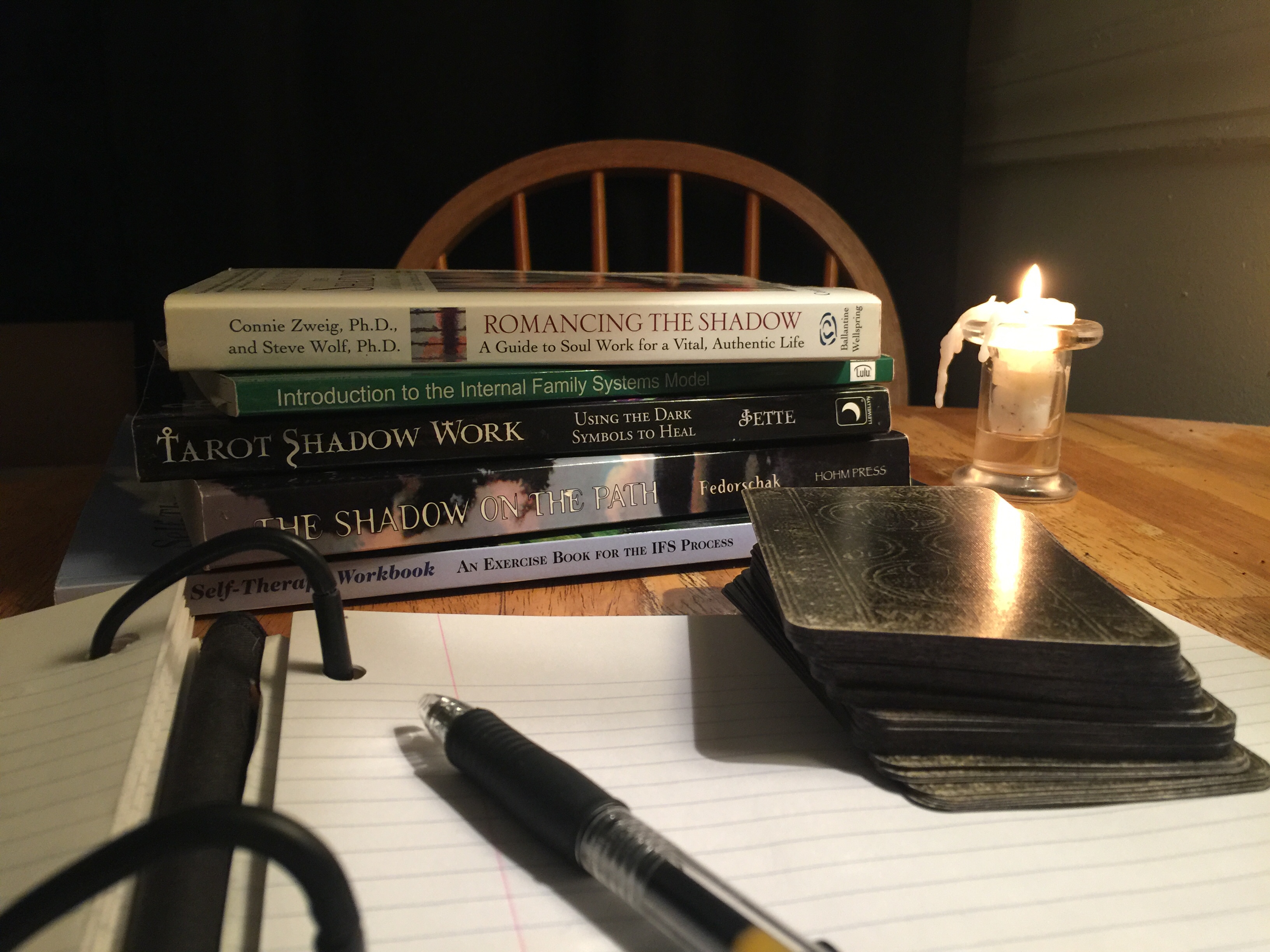
First up, get a notebook or journal. You will be asking yourself a lot of questions with the cards, exploring different aspects of their meanings, and digging down deeper and deeper, like a 2-year old asking “why?” after every single answer you get, and engaging parts of yourself in dialogue — which is all facilitated by free-form writing. Pages of it.

Step one is as simple as identifying a behavior or thought pattern that you’d like to change. I know I have plenty of these, so I’ll bet you can find one, too. In fact, I do actually keep a little list in the Notes app of my phone, which I add to when I’m out in my daily world and notice a shadow part. Later, when I’m aligned and sitting peacefully with my cards, I’ll pull out my handy dandy list and start shuffling the cards.

As a little aside, here: People often ask which decks are good for shadow work, and my suggestion is to use a deck you’re comfortable with and have a good familiarity with. You don’t need a new deck for shadow work, and you definitely don’t need a “dark” deck. The issues that come up for you may be dramatic enough, and you just want a deck that feels like a trusted friend. One of my favorite decks is Bohemian Gothic, with its cold castles and evil dwellers and creepy kids in graveyards — a vibe I love, but don’t necessarily need when trying to create a warm and compassionate approach to shadow parts. Some readers say they want an “honest” deck, but I think each of my decks is honest (or I wouldn’t keep it). Honesty lies in the reader’s interpretation, not a deck of cards. If a certain deck elicits that from you more than another, then that deck would be a good choice.

The key when beginning shadow work is to be in a place of mindfulness or a centered state, free of the complexed parts that often take the driver’s seat. I do this through a simple tripartite soul alignment using breath, but whatever practice allows this for you is right. Many do this as a regular part of their tarot practice before reading, so feel free to adopt whatever works best for you in creating a clear head or channel.

Using the cards in a more conversational style when accessing shadow parts can enable us to tap into them more easily, and function as a tool in deciphering their identities and needs. Start asking questions as you would of any close friend. “Hey, what was up with that outburst, earlier?” Some like to pull 3 cards, some prefer shuffling for jumpers- whatever feels right to you. See what insight is revealed. Ask if there is a part that would like to talk, making sure to create a warm and inviting mental space for that, and start shuffling. Ask who that part is and start shuffling. Ask about the root of that anger / fear / shame / envy / anxiety / whatever, and start shuffling, for as many questions as may be helpful in clarifying the issue or identifying and defining this part. Was there a specific incident or pattern when you were a kid that prompted this? As mentioned above, don’t be afraid to ask “Why?” over and over and over again to dig deeper down. Don’t forget to journal both your questions and the cards – you will likely be able to glean great insight over time as you move through this process, through repeating cards and connecting the dots with the way the cards portray this inner landscape.

Are there attainable goals in shadow work? Meeting our shadows is vital in spiritual practice (and in just being a better person) to help us to correct those things that cause us fear and shame and guilt, allowing us to evolve past our dysfunctions and into growth, so it is an ongoing process. It can be really effective as a tool in goals work. We can establish attainable goals and set action steps til we’re blue in the face, but without identifying the blocks we’ve put in place to protect us from harm (prevent us from stretching outside of our comfort zone), we may remain stuck in our progress without forward momentum.

So, there are many reasons why shadow work can really help to foster growth and unlock our potential, and various methods how. I’ll continue this series with spreads and questions and techniques, and add some resources in the comments, in the hopes that it grows and blossoms over time; but I hope this is helpful in getting you started with a little bit of clarity and inspiration. Now, get yourself a pen and a notebook and pull out your favorite tarot deck. Shadow work can be really challenging, but I hope and believe it’ll be an amazing journey of discovery for you!


Ace of Wands

reach out and take hold of that energy

One of the things I’ve noticed in books and other writings on shadow work is that they only talk about the trumps, as though the pips are insignificant in these matters. On the contrary; I think the cards that represent our daily interactions and feelings and responses are those we should explore first when trying to better understand the parts of our psyche. So, in this new series on the cards to include shadow meanings, we’ll start with the pips and then go into courts, finishing up with the trumps.

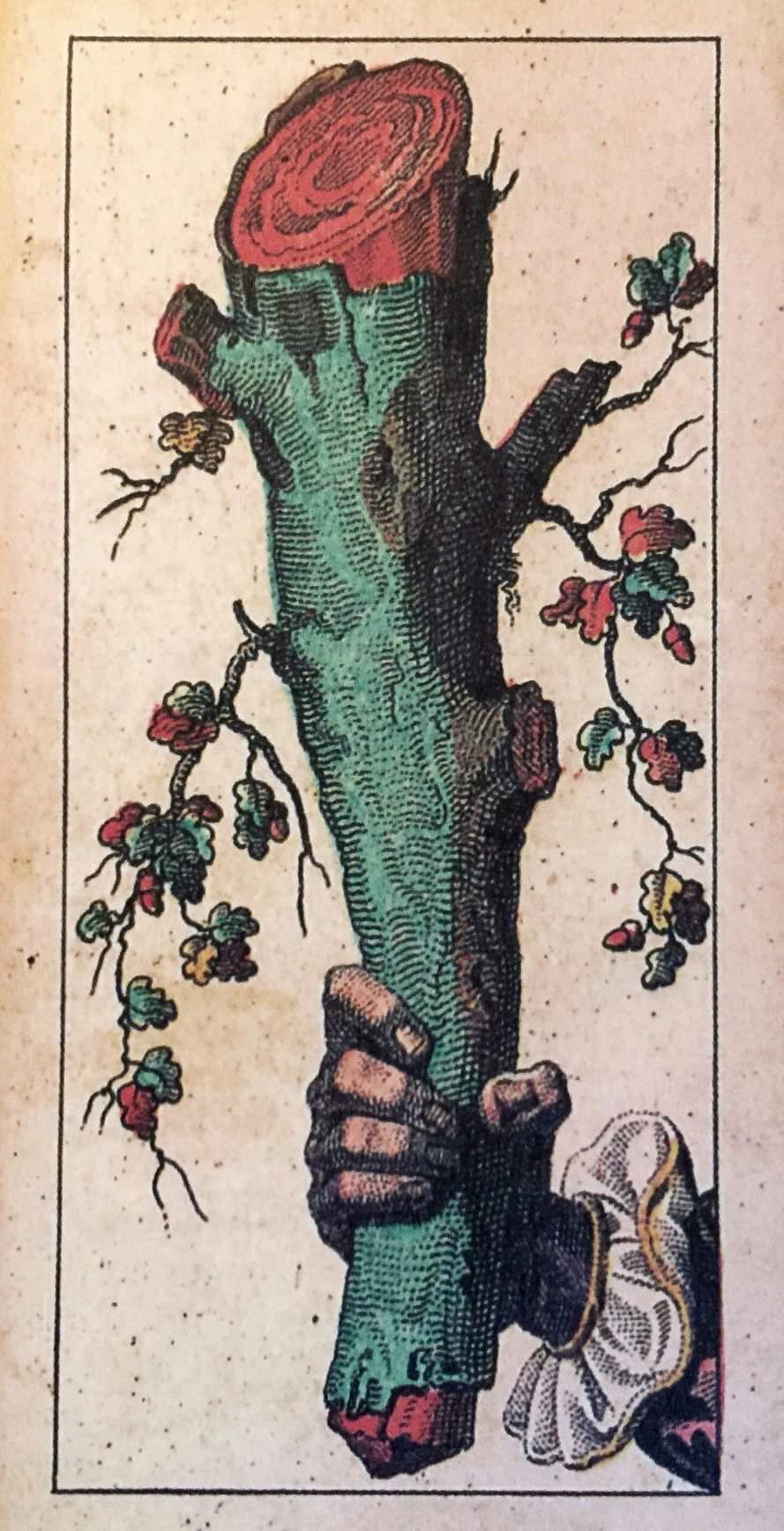
Aces are often considered some of the most amorphous of the cards. As the beginning of the suit, Aces represent the possibilities of their element — and that can seem wide open. If we consider the imagery used in the Smith-Waite decks, the Aces show an article of the suit (wand, cup, sword, or pentacle) held by a hand emerging from a cloud, indicating that there is an offering here. Will we accept it? Are we ready to step up and take it? That’s really the directive of the Aces, isn’t it? Are we going to reach out and take hold of it? What are we going to do with it? What we’re asked to confront in the shadows of this card is what is holding us back?

from Soprafino, by il Meneghello

And so, in fiery Wands, the Ace is raring to go. It’s the spark of desire, the motivation to reach up and grab that energy or desire so that we may actualize it in our lives.

In the spectrum of this card, that positive initiative is in the balanced center. On one end of the spectrum, where there is resistance, we hold back, reluctant to take what is offered. Are we not ready yet? Do we feel incapable? We may miss the opportunity out of fear, complacency, or a lack of focus. Our task here is to identify what may be holding us back.

On the other end, where there is excess, it may be counterproductive by generating hasty, impetuous, or bold behavior. By placing too much importance on it, we may jump the gun and miss the opportunity.

Questions that we may want to ask when this card comes up include:

  • Is there some fear or doubt holding you back?
  • Is there a desire you’re reluctant to allow out?
  • Are you procrastinating about something? What part of you is that serving?

But of course that’s just a beginning. How do you see this card? How has it come up for you? What is your favorite depiction of the Ace of Wands?

The Numbers of the Pips

When embarking on the study of tarot, it’s not uncommon to feel intimidated or overwhelmed by the prospect of having to memorize all of those card meanings. The thing is, though, you can more easily recall the properties of each card of the minor arcana (or pips) by simply combining the suit meaning with the number meaning.

The suits are basically the four elements – fire , water, air, and earth – each providing a different cycle, journey, or aspect of our being. So…


Wands (fire) represents energy and the inner spark that drives our actions and identities.
Cups (water) encompasses the depths of our emotional experiences and how we relate to others.
Swords (air) rules our mental processing and belief systems; where the Cups deal with the unconscious, the Swords deal with the conscious, and the ways in which we communicate and use strategy and logic.
Pentacles (earth) is the physical realm and how we as souls navigate the material world.

Now combine the suit with the number…
[There is no zero in the suits; but as long as we’re talking numbers, I’ll mention that with the zero, there is potential in the void; like conception, it’s both nothing and everything.]

  1. Initiates
    So, we start each suit with the one or ace: the beginning. Like a seed, it holds within it the fullest potential of its suit and the one comes in when we step up. In many traditional decks, we see an offering being held out to us as if from another realm. Will you take it?
  2. Unites
    With two, the ace begins to find its expression as the addition of another creates tension – whether uniting or dividing. Here we see duality and polarity, the union of opposites, and choice – with balance as the desired outcome.
  3. Expands
    In three, we see the response or reaction to the two, the result of the two, as it synthesizes further. As the three is in process of or striving for form, it‘s evolving.
  4. Stabilizes
    It becomes secure in the four, taking concrete form as in the foundation of a house or shelter. The four is stable and content as is. (I’ve also seen it postulated that four is our response to the abundance of three, which is worthy of reflection as we consider the fours in each suit.)
  5. Confronts
    The five loosens us out of that stability or status quo to confrontation. Here we are taking action in conflict, which may involve struggle or contraction.
  6. Returns or Prompts
    As one contracts, another expands, and in the six we see that natural ebb & flow or exchange of energy like the cogs in a machine or the flow of the tides, each prompting the next; perhaps completing a cycle with new info or clarity which prompts a new cycle. It’s a force which draws away from us that which we no longer need or have use for.
  7. Assesses
    The seven finds us like the eye of the hurricane – not in motion but in the midst of it. Reaction may be swirling around us but we are waiting, evaluating, considering, planning. There may be uncertainty, but this is time for internal work amidst the external noise or activity.
  8. Readjusts
    The eight is the resolution of seven with a better perspective from which to launch. It’s a realignment, and we can now open the door with a new direction or movement.
  9. Reconciles
    In nine, we near the end of the cycle and take a moment to review our journey so far or steady ourselves with the gifts of the suit as we emerge to assimilate.
  10. Completes
    As we saw the fullest potential of the element in the ace, we see the full power of the suit in the ten. The cycle is complete and we integrate its lessons while transitioning to the next cycle.

You may have different meanings for the numbers – or are inspired to find your own – and when combined with the suit meanings, this provides clarity on each pip. This is the key to reading Tarot de Marseille, but may inform all tarot card meanings.

Some correlate the number meanings up to the trumps (e.g., Magician as 1 shows full potential of what you may create) and it’s easy enough to stretch our imagination to squeeze a numerical meaning into some aspect of a card, but I see the trumps as an entirely separate component of the deck which illustrates the stages of the archetypal Hero’s Journey.

What do you think?