5 of Pentacles

ask for assistance

Five shakes us out of four’s stability and asks us to confront + Pentacles represent navigating the material realm.

from Bohemian Gothic by Baba Studios

And so the centered position of the Five of Pentacles presents a challenge in the material world — of health, of home, of finances, of our spiritual path. The security we felt in the four is gone and this uncertainty is a reminder to not be afraid to ask for assistance or sanctuary when we need it. You can’t have it if you can’t ask for it.

It may also convey a sense of being outcast or unwelcomed, and we may note that there are often comrades shown, signifying the aid of another — perhaps in a caretaking role. Inherent in many depictions of this card is that true refuge is spiritual, not material, and we may consider those in need of asylum. Social injustices and inequalities must be confronted, and this card may point to that work.

In resistance, we simply refuse to ask for assistance or connect with our higher source of power or path.

In excess, we identify with poverty or lack mentality (e.g., ‘the starving artist’). This card is a reminder to change the unconscious programming of viewing life through the lens of lack. Expecting it begets it.

Questions to consider when this card comes up may include

  • How are your needs being met? Are you lacking in some area and what can you do to secure it?
  • Is there a resource you may be overlooking even though it’s right under your nose — or are too proud to approach?
  • Is there someone who needs your help? Are you in a caretaking role, or see yourself as always taking that on?
  • Are you in search of a spiritual community?
  • Do you hesitate to ask for what you want or need? Why?
  • Do you identify with lack mentality? What parts drive that thinking?

What else? There are different aspects of this card, and you may have a different perspective. How has it come up for you? Feel free to share your insights.

5 of Swords

take responsibility for your actions

Five brings confrontation + Swords relate it to the mental realm.

from Touchstone Tarot by Kat Black

And so the Five of Swords asks us what we must confront. The Smith-Waite card shows victory at the expense of others — or a hostile defeat; and reminds us that ethics and conscience fall under airy Swords’ umbrella. Has there been an outwitting? Like a few other cards, it offers the querent the choice of which side they see themselves in (are they the victor or the victim?). The victor here appears selfish and unfair; the others sabotaged and degraded. Gore Vidal said it best with “It’s not enough to succeed; others must fail.” A sense of one-upmanship prevails throughout various interpretations.

I often like to see swords in the imagery as literally representing beliefs, and if we consider this card strictly in this context, it may indicate divisiveness, intolerance of those with different beliefs (or outsiders), arrogance, having the last word, or isolation due to an uncompromising attitude.

This card illustrates a clear power struggle (dominance vs submission). Where do you see yourself in this scenario?

in resistance, we avoid confrontation (which can sometimes lead to passive-aggressive acts). We may have a pattern of conceding to defeat, perhaps with self-pity. Are there times when you could be more assertive? There is integrity in taking personal responsibility and, as Lindsay Mack says, we can either drop into shame, guilt, and excuses or we can recenter and move on.  Sometimes we just need to get ourselves another sword.

Similar to the Five of Wands, we may also refuse to participate in or engage the behavior. In Swords, this may serve as a reminder to choose your battles wisely.

In excess, we should ask if we’re acting with the arrogant traits of the bully. Must we always get the better of others? Take responsibility and make amends if we have hurt others.

Questions to consider when this card comes up may include

  • What must you confront?
  • Is something so important to you that you must prove others wrong?
  • Is there a situation that you could have handled better? Is there some guilt around this? Is there someone to whom you could make amends?
  • What is the ethical thing to do in this situation?
  • Are you conflict-averse? Where did this originate? What parts enable this?
  • Have you adopted a defeatist attitude?
  • Are you always the victim?

There’s lot going on in this card, and more to uncover. How do you see it? How has it come up for you? Feel free to share your own insights.

5 of Cups

move through grief at your own pace

Five confronts + Cups relates to our emotional life

from Art History Tarot of Past Lives

And so, in its centered position on the spectrum, the Five of Cups invites us to confront our grief. The watery Cups long for meaningful connection, but are faced with sorrow and disappointment from something expected. We may be grieving and having a hard time letting go, but we must sit with it. We know intellectually that the pain will subside over time, and others may be telling us to put it behind us or to focus on the two remaining cups, but it’s all we feel right now and it’s valid. We must process our grief at our own pace.

In resistance, we may not be dealing with our grief at all. For so many of us, it’s easier to just ignore and repress.

In excess, we’re unable to move on, stuck in regret and failure and isolation, perhaps blaming ourselves for past loss. Or, we just expect pain and disappointment with a brooding contempt for love and relationships.

Questions we may consider when this card comes up include

  • What do you need to grieve? Can you give yourself the permission you need to do so?
  • Are ghosts from your past influencing current decisions? What parts are involved in that?
  • Are you focusing more on what you have, or what you’ve lost?
  • What chapter needs to close in your life? What can you do to welcome a new one?
  • Has your (or a part’s) mode of relating to others left you in isolation?
  • Do you default to self-recrimination, blaming yourself when outcomes have resulted in loss?

What else? These questions are by no means comprehensive but a way to get us started in thinking about the card’s many layered ways of fostering awareness and growth. How do you see it? How has it come up for you?

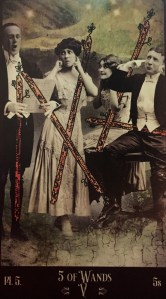
5 of Wands

establish order out of discord

Five loosens us out of the stability of four by confronting + Wands represents activity and identity.

from the Relative Tarot by Carrie Paris

And so, in the balanced center of the Five of Wands, we are invited to work it out. We may see discord, confusion, disarray, even chaos. There’s a lot going on, but there’s no real order. This card may relate to competition, and reminds us that we must be flexible enough to accommodate challenge yet sturdy enough to remain together in community (which also applies to working with the inner conflict of our parts). Are you involved in organizing others in a cause that you’re passionate about? How can you best organize to ensure that you come out on top?

Lindsay Mack has used the analogy of cleaning out the closet, where you just take everything out and throw it in a jumbled heap on the floor to be reorganized, and that analogy fits across many various applications of this card’s meaning. We may not know what we’re doing or what’s going on, but we’re invited to establish priorities and work our way through it.

In resistance, we refuse to participate in the drama or to play the game. This may serve us well in instances like the various identities involved in office gossip, but can hinder us if we feel overwhelmed by group activities like team sports. What stops you?

In excess, we may be overwhelmed with too many pots on the fire, and sometimes we just need to get out of our own way. Perhaps we thrive on being the crazymaker, creating confusion and conflict for others. What purpose is that serving for us?

Questions to consider when this card comes up may include

  • Where can you prioritize or organize? What gets in the way of your doing so?
  • Where are you competing in your life? Are you playing games?
  • Do you feel overwhelmed? What can you do to step out of that? Is there something you can put on the back burner for a little while?

What else? Lots here to unpack 😉, and you may have different ideas or insight on this card. How has it come up for you? What are some examples of this card’s energies in our lives?

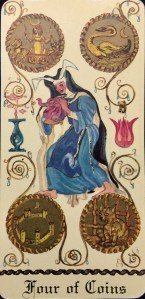
4 of Pentacles

protect your self / resources

Four brings stability + Pentacles represents material resources and navigating the physical plane.

from the Medieval Scapini Tarot

And so, in its centered or balanced position on the card’s spectrum, we consider what boundaries need to be secured. This could be around finances, solitude, space, habits, or a way of life, but may simply be linked to body, to retain a sense of autonomy or self. It may emerge from a place of scarcity, but protecting your body or other resources is an act of self-care. Self-denial can be an act of responsibility or of dysfunction; but sometimes it serves us well to hold back in order to maintain four’s stability.

In resistance, we lack boundaries to the point of oversharing our selves, our space, our time, our money.

In excess, we fear not having enough of a particular resource and rely on material security or wealth with an emphasis on gain over all else (stifling spiritual growth); building walls to keep others out; avarice, hoarding. “All you are unable to give possesses you.” ~Andre Gide

There is a sense at this end of the spectrum of being immovable. There is no feeling, no spontaneity, only rigidity.

Questions to consider when this card appears may include

  • Where do you feel vulnerable? Do you compensate by being overprotective?
  • Are you an overgiver? What drives this?
  • What do you resist giving up?

What else? Feel free to share your own insights or experiences with this card in the comments.

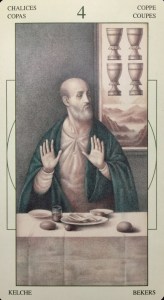
4 of Cups

feel free to abstain

Four represents a place of stability + Cups deal with our inner worlds.

from the Leonardo Da Vinci Tarot by Lo Scarabeo

And so, in the centered position on the spectrum, the Four of Cups shows the offer of a cup, but we already have those other 3 Cups and are in no need of another, yet. We’re good, thanks. We may mull it over, but really don’t feel the need to accept another at this time. If the offer is meant for us, it will be made again. This card may indicate a stationary period, taking some time for ourselves, or abstinence; but we are content. Reluctance isn’t always a bad thing, and we must always trust that we can say “no.”

In deficiency or resistance, we’re apathetic or distrusting, emotionally closed off to the offer. Aversion. Disconnected and discontented. We may have settled into an emotional pattern or cut ourselves off from those around us, perhaps holding a grudge.

If the Cups signify our emotions in the card image, what emotion or memory or part are we refusing?

In excess, we are never satisfied, becoming too discriminating or picky; unappreciative of the goodness we have.

Questions to consider when this card comes up may include

  • What or whom have you closed yourself off to?
  • Is there a memory or feeling related to the matter that you’re repressing?
  • Are parts of you unwilling to open up? How can you best tend and nurture them so that they feel heard and accepted?
  • Or, are you ignoring a part?
  • Where are you dissatisfied? Is this a pattern? What can you do about it?
  • What role has rejection played in your life?

What else? There’s much to consider in this card, and you may have different insights. How has it come up for you? Feel free to share in comments.

4 of Swords

retreat, take time to think

Fours offer stability + Swords represent our mind and its thoughts.

from Murder of Crows Tarot

In its centered position on the spectrum, the Four of Swords brings the opportunity to take a time-out to reflect on or reconcile an issue (see the Three of Swords). The stained glass may hint at a spiritual element, suggesting a time to call on our guides. Pamela Coleman-Smith’s depiction shows the medieval practice whereof knights would sometimes commission their tombs and lie on them before (or after) battle to pray (or reflect). A repose to quiet the mind or recuperate, mentally. Sometimes, we need radio silence for a proper mental reset.

In resistance, we’re not taking the time needed to clear our mind and de-stress. Unable to relax.

In excess, we’re fixed in a state of stagnation, perhaps an escape from responsibilities. This card may also indicate a forced rest.

Questions to consider when this card comes up may include

  • Do you need a mental health day? Do you deny yourself of this need out of guilt?
  • Is there something you’re trying to escape from, mentally?
  • What resources do you have in place for times of stress?

What else can we consider in this card? There is much to contemplate (see what I did, there?) and you may have other insights. Feel free to share them in comments.

4 of Wands

take a break from the activity

Fours offer stability + Wands represent energy and identity.

from the Proletariat Tarot

In its centered or balanced position is the result of will / drive. This is the quintessential thanksgiving; the harvest is in and we can celebrate our bounty. We may have attained some milestone or inner growth and are invited to relax and step away from our work to enjoy a break. Kick up your heels!

When the four’s Fire is deficient, we don’t want to make a big deal of our accomplishments or have trouble expressing gratitude. Perhaps we feel undeserving of the harvest, or don’t feel like we can take a break right now.

At the other end of the spectrum, we may be complacent, taking the fruits of our labor for granted.

Questions we may be prompted to ask when this card appears include

  • What prevents you from taking a moment to just have fun?
  • Are you taking the rewards for your labor for granted? Is it time to get back to your work?

What else? This is just one angle on it and you may have other insights. How has it come up for you? Feel free to share in comments.

A Word or Two on my Card Meanings Series

One of the things that I’ve noticed about using cards in shadow work is that no one ever goes into the shadowier meanings of the pips. The majors or trumps always get all the glory; but they represent more archetypal energies, whereas the minors or pips contain the details of our daily lives. Our actions, our frustrations, the battles we have in our minds, our desires, and so on. Why does no one include them? And so I embarked on the task to find them.

Over time, I’ve come to see each card not in a binary sense of upright and reversed, but as a spectrum. In medicinal herbalism, we aim for balance or homeostasis in tissue states, and look at conditions in terms of deficiency and excess. In deficiency, tissues are weak; in excess, overexcited and perhaps bursting. As bodies, we rarely reach homeostasis, or it doesn’t last for long, as the body is always in a state of flux, of ebb & flow and adjustment in seeking it. And so it is with our lives. Our thoughts, our feelings, our actions are constantly in the process of seeking balance; and the tarot reflects all of these various states of our lives, in their aims and aches and glories and imperfections.

So, I see each card as representing both the positive balance as well as the challenges in its particular focus, as if on a spectrum of deficiency (e.g., fears, shame causing resistance) to excess (overcompensating?), with advice or directives for attaining or maintaining that central balanced state — or, bringing shadows into light.

If we envision the spectrum as a line or seesaw, we can start with deficiency at one end, balance in the middle, and excess at the other end. Once we start exploring the concept of each card (using number + suit meanings), the spectrum often presents itself. For example, if we look at the 6 of Wands, the advice (Lindsay Mack calls them invitations, and that feels right to me) is to take pride in our achievement or victory. In deficiency, we may resist due to self-doubt, perhaps a bit of imposter syndrome. Surely, I’m not worthy of attention or praise. At the opposite end, its excess may present as grandiosity, or taking all the credit rather than acknowledging those who helped. It was actually Paul Quinn’s book Tarot for Life that lit that spark, as he lists reversals and shadows for each card in a similar way. Eureka!

As with most tarot study, this is a work in process and will always be. Just like shadow work, there will always be more to learn, more to see, more to integrate. But I feel it necessary to give credit where it’s due and offer a sort of bibliography of my own journey in coming to this project of spectrums.

The general meanings of each card have come from a compendium of various sources over about 30 years (off and on – god, I’d be an expert if I’d been studying for 30 solid years!). From my first class with Pia at Regina Russell’s Tea Room (that sumptuous style of old-school fortune-telling) to deeper and more esoteric work with Christopher Penczak, to the more trauma-informed perspective of Lindsay Mack, I always held an interest in a more psychological perspective of the cards, and was drawn to books with a Jungian lens, such as Tarot as a Way of Life by Karen Hamaker-Zondag and Discovering Your Self Through the Tarot by Rose Gawain, and Choice-Centered Tarot by Gail Fairfield (now Everyday Tarot — and while not Jungian, per se, takes a therapeutic approach).

I think that we can often look back on papers we wrote in school with an amusing sense of foreshadowing, and after studying with Christopher Penczak through five levels of training, I did my final project on using tarot for shadow work. Even returning many years later for a course on the Major Arcana, he joked after class one night of my always being a little too interested in the shadowier side of things. (Hey, I’m a double-Scorpio with my moon in the 12th house.)

Anyhoo, back to the present, one of my closest and dearest friends is a therapist using IFS (Internal Family Systems), and when she briefly explained it to me, I was intrigued enough to dig into a few books on it, and quickly saw how this approach of meeting our parts (shadow work, really) integrated so well with tarot.  Like a dog on a scent, I’m now pursuing a much deeper understanding of and experience with it.

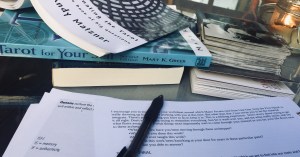
And now here I am, fitting the cards into spectrums and trying to identify questions that each may prompt. In the latter endeavor, Mary K Greer’s Tarot for Your Self and Andy Matzner’s Journaling the Tarot have been great jumping off points.

With that said, on to the fours! Please jump in with any comments or questions you may have, as I go. Discussion and debate help us all to grow.

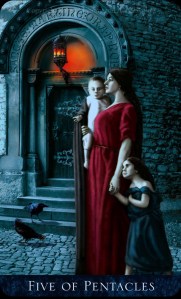
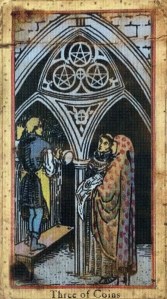
3 of Pentacles

collaborate in shared goals

Three is expansion out from the two + Pentacles represent navigating the physical world.

from the Deck of the Bastard

In its centered or balanced position, the Three of Pentacles shows us in collaboration or cooperation with others in bringing something to form. We may each have our own calling, but working together with shared goals may create the best outcome for all. In the Smith-Waite depiction (shown in the Deck of the Bastard, left), an architect creates the vision, an artist is bringing it to form, and the monk represents integrity and ethics (the three symbolizing mind, body, and soul, respectively).

The Salvador Dali Tarot urges “Do not only ask what [task] you want. Ask what God and the world want from you.” This card is about our own personal calling, and working together with others enacting their personal calling to create.

In resistance, we operate independently or at cross-purposes, failing to see the benefit of shared goals and talents. If supervised, we resent it. Talent is wasted.

In excess, we may be feeling a bit burned out. Consider what makes you happy; what gives you a greater sense of purpose?

Questions to think about when this card comes up may include

  • What are you currently working on? Does it give you a sense of purpose?
  • Do your parts work well within their system? What gifts does each offer to the whole?
  • Do you see the talents that others have to offer as gifts or do you resent them as interference?
  • Are you able to weave your own body/mind/spirit into balance? Where is there lack? Where does one take over?

What else? There’s plenty more to consider in this card, isn’t there? You may have other insights on this card. How has it come up for you? Feel free to share in comments.